NFTs, short for non-fungible tokens, have zoomed from a small craze to a massive phenomenon, catching everybody’s eye. They began with digital art and collectibles and now pop up on Web3 platforms, social media, and in businesses such as Starbucks, which is jazzing up loyalty programs. Big gaming names like Square Enix and Ubisoft are diving into this tech as well, illustrating how NFTs offer new methods to own digital treasures and maintain player interest. Observing this evolution highlights NFTs’ usefulness for a wide audience beyond blockchain enthusiasts. Isn’t it incredible how adaptable and far-reaching NFTs have turned out to be?
What Are NFTs?
Non-fungible tokens (NFTs) are distinctive digital assets, each with a unique identifier, that distinguish them from all other tokens on a blockchain. They are created using smart contracts on blockchain platforms, which ensures that no two NFTs are identical. This uniqueness and the secure, decentralized ownership model provided by blockchain technology have propelled NFTs into various applications. They’ve become popular in the realms of digital art, video gaming, and finance, opening new avenues for creativity, ownership, and investment. The potential uses for NFTs continue to grow, highlighting their versatility and the expanding interest in digital and decentralized solutions.
What Are NFT Games?
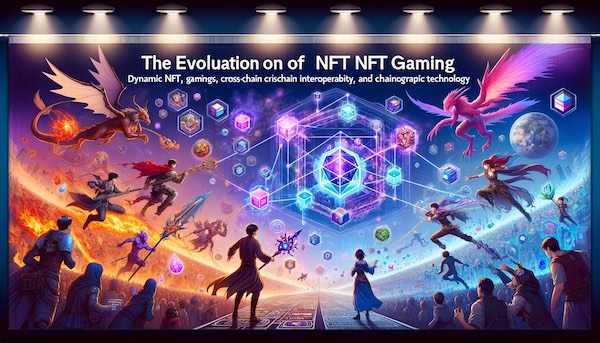
NFT games incorporate Non-Fungible Tokens (NFTs) as a fundamental component, utilizing them to represent various in-game assets like characters, items, weapons, and skins, each with a unique identifier on the blockchain. This integration of NFTs into gaming unlocks several benefits not found in traditional video games.
Sovereign Ownership
Unlike traditional games where in-game assets are controlled by the game’s developers on centralized servers, NFT games grant players true ownership of their digital items. This mirrors the ownership of physical collectibles, enhancing player engagement and immersion. The permanence of these digital assets is guaranteed as long as the blockchain exists, offering a level of security and permanence previously unavailable in digital gaming.
Interoperability
NFT games built on the same blockchain share a common infrastructure, allowing for interoperability among different games. An NFT acquired in one game can be used in another, opening up unique cross-game interactions. This interoperability extends to the broader Web3 ecosystem, enabling NFTs to be utilized in various applications and contributing to the development of a connected digital metaverse.
Monetization
The integration of NFTs into games also introduces a new economic model. Players can trade their NFTs in open blockchain marketplaces, potentially earning real money, while developers can benefit from royalties on NFT trades. This economic framework supports a more open and player-driven market, contrasting with the closed economies of traditional games.
NFT Game Examples
NFT games span a broad spectrum, from titles that infuse traditional gameplay with blockchain benefits to entirely new digital realms built collaboratively by communities. Here are a few examples:
Gods Unchained
- Gameplay: A trading card game akin to Hearthstone and Legends of Runeterra, where players engage in player-vs-player (PvP) matches using a deck of cards.
- NFT Aspect: Cards are NFTs, giving players full ownership and the ability to trade on the game’s marketplace. This model parallels physical trading card games, offering the digital convenience without sacrificing ownership rights.
Dookey Dash
- Gameplay: An endless runner game where players compete for high scores on a leaderboard, similar to Subway Surfer or Temple Run.
- NFT Aspect: Entry to the game is granted via access pass NFTs, distributed to Bored Ape Yacht Club NFT owners or purchased on the open market. High-scoring players receive NFT rewards with utility in the broader BAYC universe, integrating NFTs as both access tokens and rewards.
Loot
- Gameplay: An unconventional approach where the game begins as a collection of text-based NFTs listing items without any images.
- NFT Aspect: These NFTs serve as a foundation for community-driven development, where developers, creators, and players build various games and experiences using the items described in the NFTs. This open-ended model encourages collaborative world-building and creativity.
These examples illustrate the versatility of NFTs in gaming, from enhancing traditional game models to fostering innovative, community-driven projects.
Chainlink Services in NFT Games
In the evolving landscape of NFT games, overcoming technical limitations is key to achieving mainstream success. Chainlink, a leader in providing Web3 oracle services, plays a pivotal role in addressing these challenges. By enabling NFT game developers to integrate off-chain data seamlessly, Chainlink facilitates the creation of more immersive and dynamic gaming experiences.
Chainlink’s Role in NFT Games
NFT games often rely on a combination of smart contracts for NFT creation and traditional servers for game mechanics, due to the scalability challenges of blockchain technology. However, a major hurdle is the inability of smart contracts to access data outside the blockchain natively. This limitation restricts the potential for NFTs within games to be more than static assets.
Dynamic NFTs (dNFTs)
Dynamic NFTs (dNFTs) represent a solution to this issue. They are NFTs whose attributes can change based on external data or events. For instance, an in-game weapon could evolve and improve as a player progresses, or a character might gain new abilities. The key to enabling this functionality is access to reliable off-chain data sources.
Chainlink Functions
Chainlink Functions is a service that bridges this gap. It allows game developers to connect their NFTs to any external API quickly and securely, transforming static NFTs into dynamic assets that react to game events, player achievements, or other conditions. This serverless platform empowers developers to create dNFTs by providing a straightforward way to feed off-chain data into smart contracts.
Through services like Chainlink Functions, NFT game developers can enhance the gaming experience, offering players the opportunity to engage with NFTs that are not only unique but also capable of growth and change. This not only enriches gameplay but also adds a layer of depth to the digital assets owned by players, pushing the boundaries of what’s possible in NFT gaming.
The Cross-Chain Interoperability Protocol
The Cross-Chain Interoperability Protocol (CCIP) is a groundbreaking oracle service aimed at enabling seamless communication between different blockchains. This development addresses a critical challenge in the blockchain ecosystem: while applications within the same blockchain can easily interact, those built on different blockchains cannot. This limitation significantly impacts NFT games, which strive to reach and engage players across multiple blockchain platforms.
The Challenge of Blockchain Fragmentation
Currently, the blockchain landscape is fragmented, resembling the siloed ecosystems of traditional gaming publishers, where each platform operates independently. For NFT games, this fragmentation complicates efforts to tap into a broader player base, as players prefer the convenience of staying within a single blockchain ecosystem. The result is that game developers are forced into costly and inefficient measures to redeploy their games across multiple blockchains, a process that is neither scalable nor practical as the number of blockchains grows.
CCIP’s Role in Enhancing NFT Games
CCIP aims to eliminate these barriers by providing the tools necessary for developers to create natively cross-chain applications. This protocol envisions a blockchain ecosystem where applications, including NFT games, can communicate and operate across different blockchains seamlessly. Such interoperability would not only improve the user experience—enabling players to use a single wallet across the entire blockchain universe—but also allow NFT games to leverage the specific advantages of different blockchains, such as optimizing for speed or cost.
The introduction of CCIP represents a significant step towards a unified blockchain ecosystem, breaking down the current silos and opening up new possibilities for NFT gaming. By enabling true cross-chain functionality, CCIP has the potential to foster a more connected, accessible, and efficient blockchain network, greatly benefiting developers and players alike in the expanding universe of NFT games.
Chainlink Verifiable Random Function
The integration of randomness in games is crucial for elements like loot distributions, procedural content generation, and various gameplay mechanics. However, achieving genuine randomness on blockchain platforms poses a unique challenge due to their transparent and deterministic nature. Traditional gaming can rely on hidden random number generators (RNGs), but blockchains require a solution that ensures fairness and transparency without compromising security.
The Challenge of Secure Randomness in Blockchains
In NFT games, where distributions and in-game mechanics often depend on randomness, the lack of a secure, transparent source of randomness can undermine fairness and player trust. This is particularly relevant for features like NFT giveaways, airdrop allowlists, and dynamic game functions, where predictability could lead to exploitation and unfair advantages.
Chainlink Verifiable Random Function (VRF)
Chainlink’s Verifiable Random Function (VRF) addresses this challenge by providing a provably fair and tamper-proof random number generation mechanism for blockchain applications. Chainlink VRF operates with transparency at its core, allowing any participant to independently verify the randomness and integrity of the number generated. This capability is vital for maintaining fairness in NFT distributions and ensuring that game outcomes are not only unpredictable but also verifiably random and unbiased.
The Impact of Chainlink VRF on NFT Games
By integrating Chainlink VRF, NFT game developers can enhance gameplay with truly random events, such as fair loot drops, unbiased map generation, and unpredictable critical hits, among others. This level of randomness, combined with the transparency and security of blockchain technology, fosters a gaming environment where players can trust in the fairness of the game mechanics and the distributions of valuable digital assets.
Conclusion
As NFT games continue to evolve and experiment with new gameplay and monetization models, the role of technologies like Chainlink VRF becomes increasingly important. It not only solves a fundamental challenge of blockchain-based gaming but also opens up new possibilities for developers to innovate while maintaining a commitment to fairness and transparency. The future of NFT gaming, built on the principles of sovereign ownership, interoperability, and secure randomness, promises a more engaging and trustworthy digital gaming landscape.