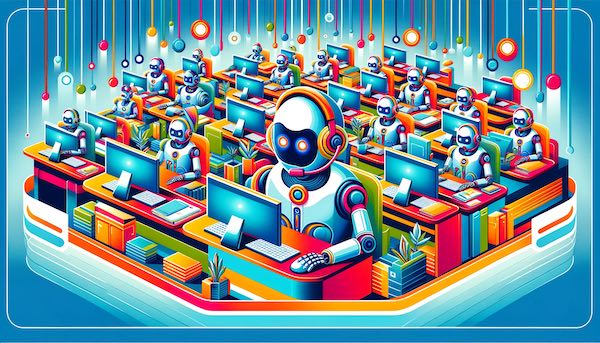
The AI revolution changes how we use tech every day, bringing in smarter AI and robots. Seeing talking human-like robots and nimble, dog-like machines doing tricks stirs up wonder and surprise—feelings that once seemed straight out of sci-fi. Fast advances in machine learning mean fully interactive robots might not be too far off.
AI’s prowess in automation is reshaping the workforce, taking over tasks traditionally done by humans and sparking debates about job security and the future of work. Yet, history shows that innovation often opens doors to new opportunities and job roles while highlighting the limitations of existing ones.
A recent Gartner report predicts a nuanced impact of AI on employment: although millions of jobs may be phased out, AI is expected to generate a net increase of two million new jobs by 2025. This article explores ten professions likely to be replaced by AI and ten that will remain largely unaffected by AI advancements.
What jobs will AI replace?
The transformation driven by artificial intelligence (AI) draws parallels with past shifts in employment due to technological advancements, such as the drastic reduction of agricultural jobs from nearly half of the US workforce at the 19th century’s end to between 1 and 2% today. The mechanization of agriculture, marked by the introduction of tractors and other technologies, led to the displacement of millions of jobs and propelled former farmworkers towards urban factory roles, reflecting a significant migration from primary to service sectors, where nearly 80% of Americans work today.
This historical context raises important questions about the future of work in the age of AI, a general-purpose technology with the potential to pervade every facet of our economy and society, much like electricity did. AI promises to enhance efficiency and convenience in various aspects of daily life, yet its adoption is gradual, suggesting it may be years before AI fully supersedes human roles in the job market.
10 jobs replaced by ai
- Customer Service Representatives: AI can handle repetitive customer inquiries with automated responses, such as delivery status or refund queries. Complex issues can still be escalated to human representatives.
- Receptionists: Robots and AI systems like AimeReception are being deployed for reception duties in many corporations, capable of interacting with guests much like human staff.
- Accountants/Bookkeepers: AI-driven bookkeeping services offer efficient, secure, and flexible accounting solutions, significantly reducing the need for human accountants for routine data entry and analysis tasks.
- Salespeople: The evolution of advertising and retail towards digital platforms reduces the need for traditional sales roles, as AI can now personalize product recommendations based on consumer behavior.
- Taxi and Truck Drivers: Autonomous driving technology is advancing rapidly, with companies like Uber, Lyft, and Waymo working towards vehicles that operate without human drivers, signaling a significant shift in the transportation industry.
- Retail Services: AI and robots are transforming the retail sector, taking over tasks such as inventory management, payment collection, and customer queries. Innovations like Amazon Go and robotics solutions like Tally for stock auditing indicate a future where human roles in retail are significantly reduced.
- Proofreaders and Translators: AI-powered writing aids, such as Grammarly, and translation tools like DeepL and Google Translate, are becoming increasingly reliable for proofreading and translating texts, diminishing the demand for human proofreaders and translators.
- Security and Military Personnel: AI is being integrated into security and military operations to minimize human casualties. Advances in surveillance technology and autonomous military vehicles suggest a future with less direct human involvement in security and combat roles.
- Surgical Assistants: The precision and efficiency of AI and robotics in surgery are paving the way for robotic assistants to replace human surgical teams, potentially reducing human error in medical procedures.
- Courier Services: Companies like Walmart and Amazon are experimenting with drones and robots for delivery services, signaling a shift towards automated logistics and courier services that could eclipse traditional roles in this sector.
What jobs will ai not replace?
While artificial intelligence (AI) is poised to reshape numerous industries, its capacity to completely supplant human roles is bounded by inherent limitations. Contrary to some sensationalist claims, AI won’t “take over the world” but will instead spur the creation of new sectors and millions of jobs that necessitate the unique capabilities of human beings.
AI’s utility is largely confined to executing predefined tasks, necessitating ongoing maintenance and oversight. It falls short in areas requiring nuanced judgment, such as conducting market research analysis or resolving interpersonal disputes. Lacking in critical thinking and original creativity, AI operates primarily on the outputs of human intellect.
Furthermore, AI does not possess social or emotional intelligence; it cannot comprehend concepts of safety, privacy, or ethics, nor can it experience or express emotions. This delineates clear domains where human involvement remains indispensable.
Jobs Unlikely to be Replaced by AI
- Chief Executive Officers (CEOs): Leadership roles that require grit, instinct, and visionary capabilities remain beyond AI’s reach, as technology cannot replicate human leadership qualities.
- Lawyers: The nuanced reasoning and emotional intelligence necessary for legal strategy and argumentation are qualities AI currently lacks, preserving the role of lawyers.
- Graphic Designers: Despite advances in AI, the deep artistic understanding and creativity needed to conceptualize and execute original designs ensure the continued relevance of human graphic designers.
- Editors: The comprehensive review process, including consideration of audience and intent, as well as accuracy and depth, remains a human skill set not replicable by AI.
- Computer Scientists and Software Developers: The varied and specific demands of software development, requiring creative problem-solving and innovation, secure the role of human developers, although AI may change how they work.
- PR Managers: The personal touch required in public relations, from relationship building to campaign engagement, is something AI cannot emulate.
- Event Planners: The complexity of event planning, requiring coordination and customization, is beyond the capabilities of AI, necessitating human involvement.
- Marketing Managers: While AI can predict trends and performance, the creative and strategic decision-making in marketing remains a human domain.
- Teachers and Educators: The personal connection and emotional intelligence required to effectively teach and inspire students safeguard the profession from automation.
- Writers and Authors: The creative invention and storytelling inherent to writing are uniquely human traits that AI is unlikely to replicate fully, securing the future of human writers and authors.
How Many Jobs Will AI Replace By 2030?
The World Economic Forum predicts that artificial intelligence (AI) will replace approximately 85 million jobs by 2025 as industries increasingly adopt autonomous robots and generative AI technologies. This transformative wave is expected to extend across all sectors, with new industries likely emerging that inherently incorporate AI and robotics from their inception. The future landscape of work will be fundamentally shaped by digital technology, data science, and AI innovations.
Emerging Professions Shaped by AI
- Data Scientists: Among the most sought-after roles today, data scientists analyze complex datasets to identify trends, behaviors, and insights, driving smarter business decisions. Described as part mathematicians, part computer scientists, and part trendspotters, they are pivotal in harnessing the power of data for technological advancement.
- Artificial Intelligence and Machine Learning Engineers: These professionals often collaborate closely with data scientists to develop and implement AI models. The demand for machine learning engineers is expected to rise sharply, paralleling the need for data scientists, with a particular emphasis on coding and computer science expertise.
- Data Labeling Professionals: As data becomes increasingly critical across various sectors, the demand for professionals who can accurately label data to train AI models is expected to grow. Data labeling may emerge as a fundamental, high-demand job category in the AI-driven economy.
- Hardware Specialists for Artificial Intelligence: Specialists in AI hardware development, particularly those capable of designing and manufacturing advanced GPU chips and other specialized components, are poised to become highly sought after. With major tech companies like Intel and collaborations between Facebook and Qualcomm focusing on creating AI-specific chips, this field is expected to see significant job growth.
As AI reshapes the global economy, these and other emerging roles will play critical roles in defining the future of work, highlighting the dual nature of AI’s impact: while displacing certain jobs, it also creates new opportunities and professions.
Bottom Line
Embracing artificial intelligence (AI) as an integral part of daily life and work is becoming increasingly essential. All job roles can benefit from the efficiency and cost-saving solutions AI provides, freeing up human capacity for more creative and strategic pursuits by automating decision-making processes and routine tasks. The potential of AI to propel businesses forward, streamline manufacturing, and unearth valuable insights is immense. Its application spans a broad range of industries, from logistics and manufacturing to cybersecurity, demonstrating its versatility and impact. Additionally, small businesses have made significant strides in developing speech recognition software for mobile devices, showcasing AI’s accessibility and utility across the business spectrum. Recognizing and integrating AI’s capabilities into various sectors not only enhances operational efficiency but also opens up new avenues for innovation and growth.